


Tips
On the AEMET website we can obtain the weather conditions, up to 4 days, by means of graphic information with wind and wave height maps with image animation.
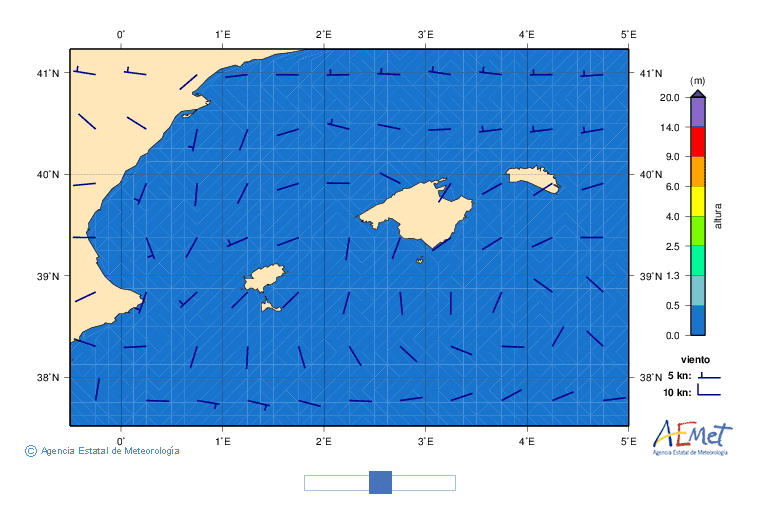
This is AEMet’s service for maritime navigation in which you enter the dates of departure and arrival, click on the route on the map, and obtain wind and sea information.

Menorca Radio (CCR Valencia – MMSI 002241024), channels 16 and 70, 85 duplex, and 06 simplex Sasemar. Weather bulletins on channel 16-85 at 06:10, 15:03 and 20:10 in summer, local time (-1 hour in winter). Notices to Mariners at 06:10 and 18:10.

You should come to their aid as quickly as possible, provided you do not endanger your own safety. Contact (VHF channel 16 or 2.182 Khz) the nearest Maritime Rescue Center or Coast Radio Station and contact other vessels in your vicinity. If you do not have communication equipment, warn other nearby vessels with distress signals. If you are unable to render assistance, proceed to the nearest port to report the situation.
Check with our staff the good condition of the boat and check the proper functioning and condition of:
- Navigation and communications equipment
- Engines, electrical system and levels (oil, fuel and water)
- Rigging
- Safety equipment
Check that life jackets are worn for all crew members. While sailing, children must wear life jackets at all times. You will be given the:
- Manual of use of the boat
- Chart of the authorized navigation zone, with indication of marine reserves and anchorage areas.
- Graphic cards of the Coves and their authorized anchorage areas.
Be informed of the weather forecast for the area where you intend to sail, avoiding departure in case of bad weather or poor visibility. Inform us of your sailing plan, as well as the estimated time of arrival if it is before 7 p.m., in order to receive notice of any eventuality, thus avoiding the passage of a few hours that could be vital in any emergency.
Have sufficient information about the route and ports you expect to visit: charts
nautical charts, route maps, lighthouse book, buoys, anchorages, available moorings
, etc. Do not forget that it is strictly forbidden to moor to the buoys
.
Do not embark on your boat more crew members than allowed.
You must carry a bag to store the garbage generated in order to deposit it at
land. It is forbidden to throw any waste into the sea.
Carry your cell phone with a charged battery and protected from water.
You have at your disposal a free emergency telephone number (900 202 202), to be used in alerts for people who from land can warn of a dangerous situation at sea (sighting of flares, relatives who have no news of people on board pleasure boats, etc).
Download Check List- Remember that the skipper is responsible for the boat and its crew.
- Remember that extreme caution must be exercised in port and that “professional” vessels have priority over recreational vessels.
- Remember that both in port and within 200 meters of unmarked beaches or 50 meters from the rest of the coast, you must sail at less than 3 knots.
- Keep the awning folded down, as it will be seriously damaged at speed.
- Remember that on the high seas you must maintain a constant and effective visual and auditory vigilance to avoid possible collisions and/or collisions at sea.
- Moderate speed close to shore to avoid running aground on rocks near the surface.
- Remember that the depth sounder does not warn us of the dangers ahead. It is a tool we use for anchoring. Try to sail at a constant speed and do not make sudden changes of course.
- Do not hesitate to order life jackets to be put on at the slightest sign of worsening sea conditions. Children should always wear life jackets.
- Whenever possible, attack the waves obliquely, at 45º, avoiding going through the sea, given the danger of rolling; as well as catching the waves with the bow, giving pantocazos, bad for the crew and for the boat.
Fortunately, there are more and more marine protected areas. Among the marine ecosystems, it is worth mentioning the underwater prairies dominated by the Mediterranean sea grass Posidonia oceanica.
It is forbidden to anchor on the seagrass meadows in the areas catalogued as Sites of Community Interest (SCI) and Special Areas of Conservation (SAC), with boats of the surveillance service against anchoring on posidonia meadows centered in the areas of Es Grau, Son Saura, the marine area south of Ciutadella, Llucalari, Calecoves, Punta Prima and Isla del Aire.
In Menorca we have the marine reserve of North Menorca.
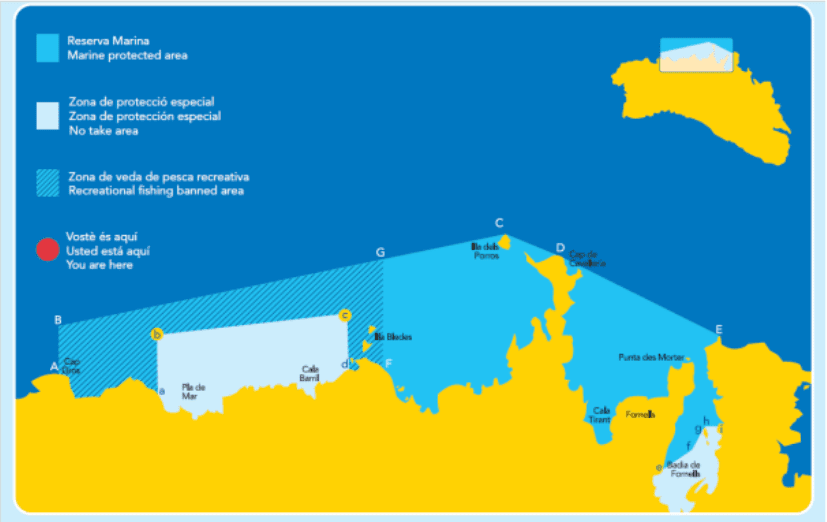
Fishing and scuba diving are not allowed in the special protection areas. Anchoring in the phanerogam meadows is prohibited. In the recreational fishing closed area, recreational fishing is not allowed from the shore or from a boat. Professional fishing and scuba diving are allowed. In the rest of the marine reserve, professional fishing, recreational fishing and scuba diving are permitted and regulated.
In Menorca there are two buoy fields available: Illa den Colom and Cala Fornells.
http://www.cbbasea.com/landing/index.html
It is forbidden to moor two boats at the same buoy. Reservations can be made until 9.00 a.m. on the day of arrival at the buoy field.
Info: Monday-Friday 9h-19h. 971 43 97 79 / 971 43 97 52
The mooring to the reserved buoy must be done between 12:00 am and 6:00 pm on the day of arrival. On the day of departure, the buoy will be free before 11:00 am. Payment must be made at the time of booking. If there are no buoys of the size of your length, you will be automatically assigned a buoy of a greater length at the corresponding rate.
Boats with a confirmed reservation that want to leave the course for a certain period of time must communicate it to the course skipper (channel 77 VHF). Otherwise it is not guaranteed to be free upon return. When there is no availability, anchoring is only allowed in sandy areas outside the perimeter of the field, avoiding that the anchor and chain damage the posidonia.

We must anchor only in places authorized for this purpose, marked on the chart, taking into account the prohibition that both the anchor and the chain are on oceanic posidonia meadows, heavily fined.
We must remember that priority is always given to bathers and divers, so the approach must be made at very low speed, less than 3 knots, since we are less than 200 meters from the cove or unmarked beach.
You should choose to anchor in a cove or area protected from wind and waves, with a sandy bottom and between 4-7 meters deep if our draft or depth of the boat is about 50 cm, using the depth sounder to check the depth.
We should not anchor close to other boats, being aware that, if the wind changes direction, all boats will turn around their anchor, at different speeds depending on how their shapes are affected by the wind. The anchor is set, making sure that the end of the line is tied to the boat, and the anchoring point should be reached without speed and upwind. At this point we will drop the anchor and chain/line to between 3 to 6 times the depth, more the more wind and swell we have.
To avoid accidents with the propeller, no one should swim until the engine is stopped and we have checked that the anchor has grabbed properly. Likewise, before starting the engine and weighing anchor, all crew members must be on board.